Why do people react so differently to the same situation?
Explore prediction, previous experience, physiology, development and context.
 Neurobiological Architects
Understanding behaviour
Explore how brain, body, development, experience, relationships and environment interact across everyday human behaviour.
Start with the question or situation that brought you here. You can explore without having to know the explanation first.
Start with what is happening
Explore prediction, previous experience, physiology, development and context.
Understand how state can alter access to attention, memory, flexibility and control.
Explore learning, prediction, repetition, reward and energy-efficient brain processes.
Consider how relationships, environment and expectations become part of experience.
Look beneath conscious explanation to the processes operating before behaviour becomes visible.
Follow a broad pathway through the biology and psychology of human behaviour.
A way through
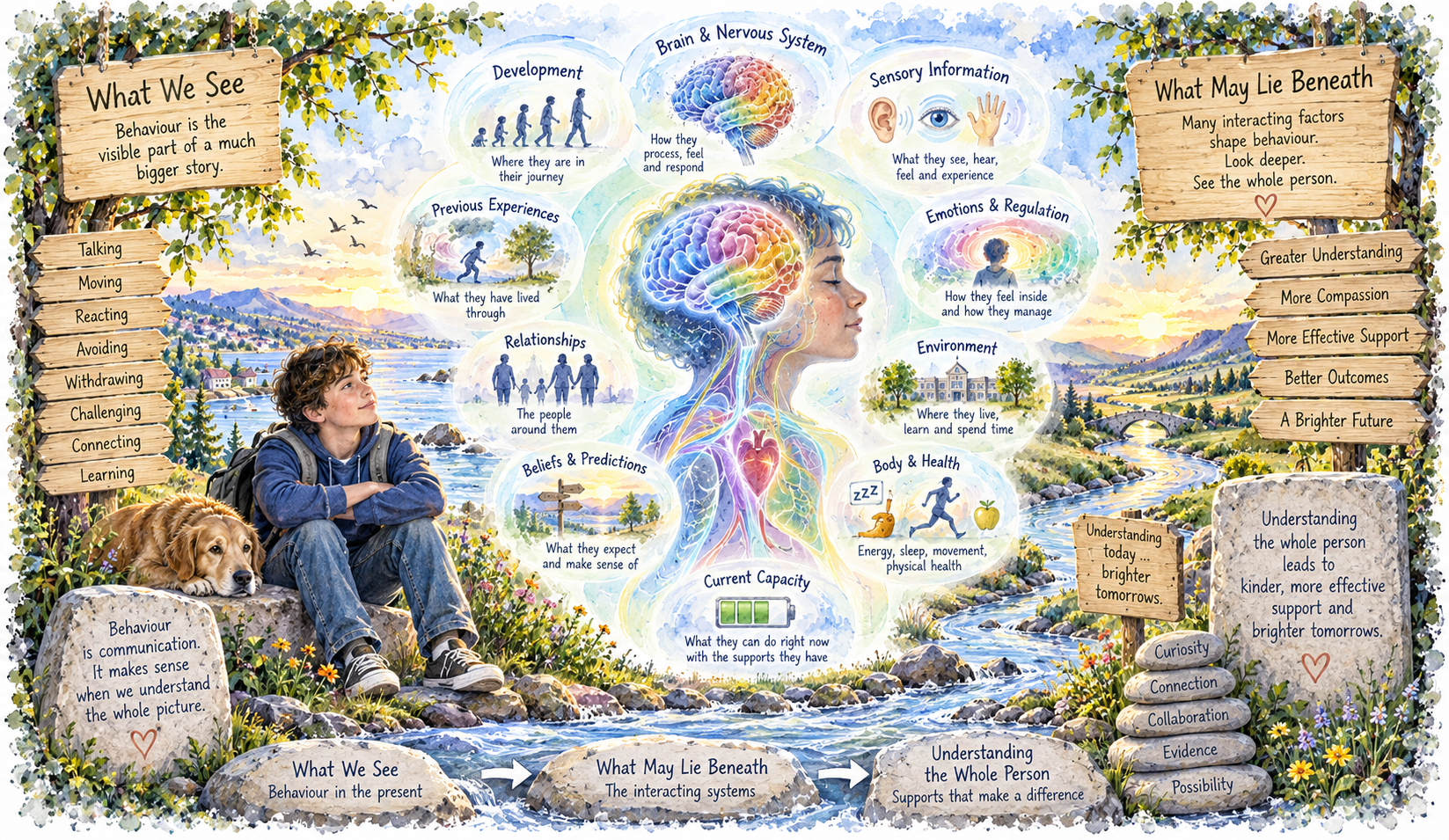
Look beneath what you can see and begin with the whole person.
Consider the systems, experiences and conditions that may matter.
Bring the pieces together without assuming one explanation is the answer.
Use understanding to guide supportive next steps and useful resources.
Explore
Different domains can interact. These are places to explore, not conclusions about the person.
Understand the biological system from which behaviour emerges.
Explore how bodily state participates in thought, emotion and action.
See behaviour in the context of change across the lifespan.
Consider how learning and previous experience shape present responses.
Explore how other people become part of our predictive and developmental environment.
Understand why behaviour cannot be separated completely from context.
Consider
Understanding develops when we consider how different conditions may interact for this person, in this context, at this time.
Possible contributors are hypotheses to explore, not conclusions about the person.
Find a way forward
These resources can help deepen understanding of what may be worth considering. They do not determine why a particular person is behaving in a particular way and do not replace individual clinical assessment, diagnosis, medical advice, safeguarding or other appropriately qualified professional support.