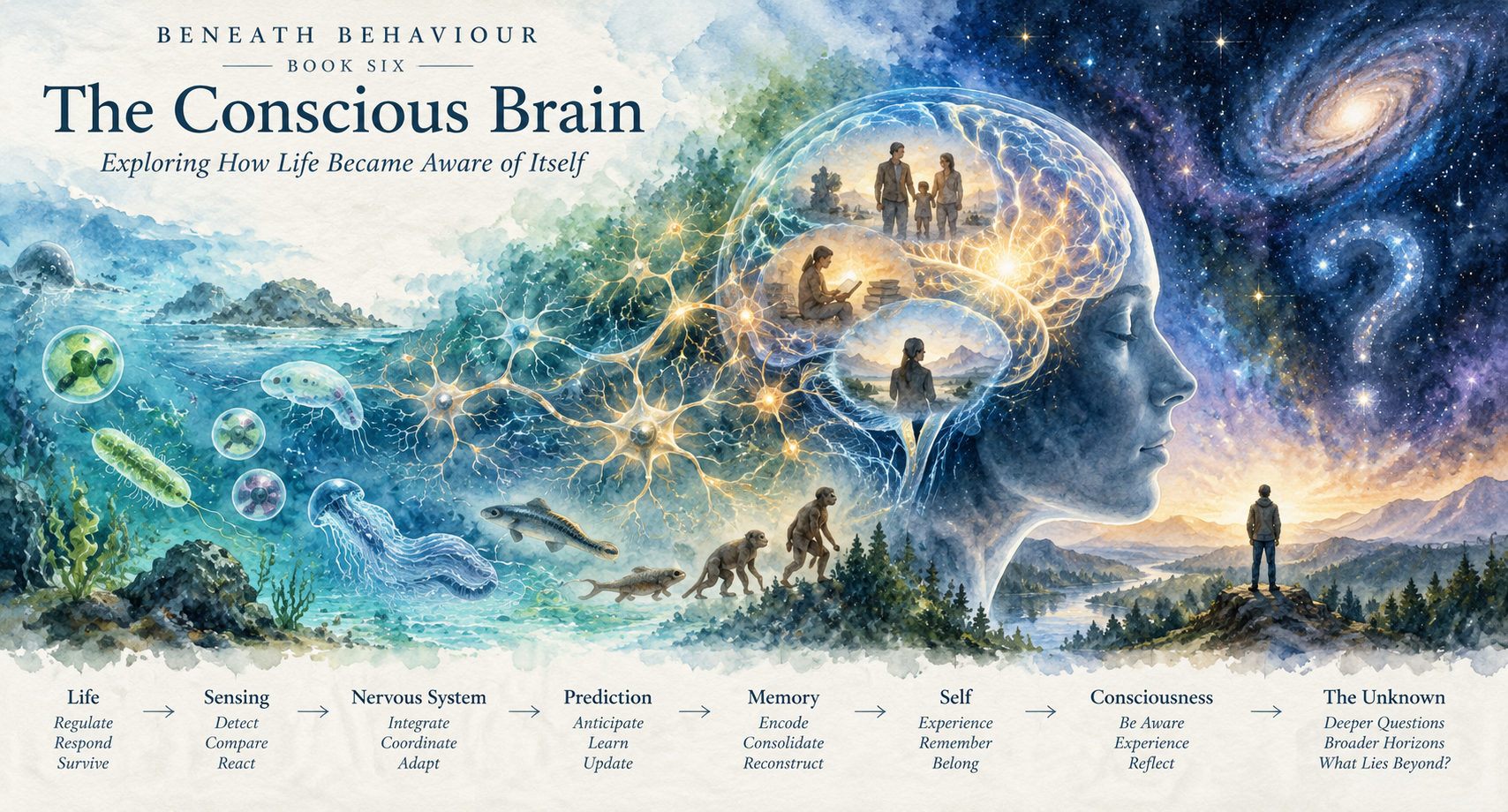
From life before minds, through prediction, memory and identity,to the leading theories of consciousness and the edge of what science can say.
Book Six asks how a living biological system became capable not only of sensing and responding to the world, but of experiencing it. Its starting discipline is crucial: complex behaviour does not automatically demonstrate consciousness.
Part I: From Life to Conscious Experience
Chapters 1–6
• Chapter 1 begins before brains. Homeostasis, cellular sensing and bacterial chemotaxis show that life can regulate, compare and respond without confirmed subjective awareness.
• Chapter 2 separates sensing, information processing, awareness and consciousness. It treats awareness as a possible evolutionary continuum rather than a single switch.
• Chapter 3 follows the emergence of neurons, nerve nets, ganglia and centralised brains. Nervous systems make rapid integration and coordinated whole-body action possible.
• Chapter 4 explains prediction as an evolutionary advantage. Brains use past regularities to anticipate what may happen next, while prediction error drives learning and model updating.
• Chapter 5 reframes memory as a living biological process of encoding, consolidation, retrieval and reconsolidation rather than a fixed archive.
• Chapter 6 asks when all of this processing became felt experience. The book deliberately does not claim a precise evolutionary moment because current evidence cannot establish one.
Part II: Memory, Other Minds and the Story of Self
Chapters 7–11
• Chapter 7 turns to the social brain. Other minds create a demanding prediction problem involving trust, cooperation, reputation, intention and communication. Language and culture allow knowledge to accumulate across generations.
• Chapter 8 examines how memories are physically made. Synaptic plasticity, hippocampal organisation, systems consolidation and sleep transform fleeting experience into more durable distributed change.
• Chapter 9 shows why memory is reconstruction rather than replay. Present context, emotion, expectation and later knowledge can become part of what is remembered. Confidence therefore cannot be treated as a guarantee of accuracy.
• Chapter 10 asks how reconstructive memories can nevertheless support a continuing identity. Autobiographical memory, the default mode network, relationships and language contribute to a continually updated narrative self.
• Chapter 11 uses amnesia and dementia to test that account. Different memory systems can be disrupted differently, showing that identity is distributed and that relational, emotional or procedural capacities may remain even when explicit autobiographical memory is impaired.
Part III: How Science Tries to Explain Consciousness
Chapters 12–15
• Global Workspace Theory proposes that conscious access occurs when selected information becomes widely available across otherwise specialised brain systems. The theatre metaphor contrasts extensive unconscious backstage processing with information entering the conscious spotlight.
• Integrated Information Theory proposes that consciousness relates to the degree and structure of information integration within a system. Its mathematical ambition and clinical links to perturbational complexity are considered alongside major disputes about testability.
• Predictive processing proposes that perception is active inference: the brain generates expectations, compares them with sensory evidence and updates its models through prediction error. It offers a powerful unifying framework but does not by itself explain why processing should feel like anything.
• Chapter 15 compares these approaches without declaring a winner. The book distinguishes established findings from theoretical proposals and genuine unknowns, then considers future work in connectomics, computational neuroscience, neuroimaging, artificial intelligence and brain organoids.
Part IV: At the Edge of What Science Knows
Chapter 16 · The River Beneath the River
The epilogue asks whether consciousness can be fully explained through the brain-as-computer metaphor. It examines Orch-OR, microtubules, anaesthesia-related findings and quantum proposals. The chapter does not present these ideas as established. It places supporting experiments beside major objections concerning decoherence, empirical testability and explanatory sufficiency.
Chapter 17 · Where Does God Fit Into All This?
The afterword moves from a scientific question to the boundary of science itself. Neuroscience can investigate mechanisms, neural correlates, anaesthesia, injury, perception and models of self. It cannot currently determine why anything exists, whether existence has a purpose, whether consciousness is ultimately fundamental or created, or whether God exists. The chapter explicitly cautions that these unanswered questions are not evidence for God; they identify the limits of what empirical neuroscience can presently establish.
What the complete book leaves us with
• Consciousness is best approached as an unresolved scientific problem rather than a settled explanation.
• Behaviour, information processing and subjective experience must remain conceptually distinct.
• Memory is reconstructive, prediction is fundamental to brain function, and identity emerges from distributed interacting systems.
• Competing theories advance the field even when their predictions conflict or fail.
• Evidence, theory, speculation and metaphysical belief should remain clearly distinguished.