A presentation has multiple possible contributors
Use an integrated formulation frame to organise hypotheses without prematurely privileging one domain.
 Neurobiological Architects
Healthcare & allied health professionals
Explore behaviour through the interaction of neurobiology, physiology, development, experience, relationships and context without collapsing complexity into a single explanation.
Start with the question or situation that brought you here. You can explore without having to know the explanation first.
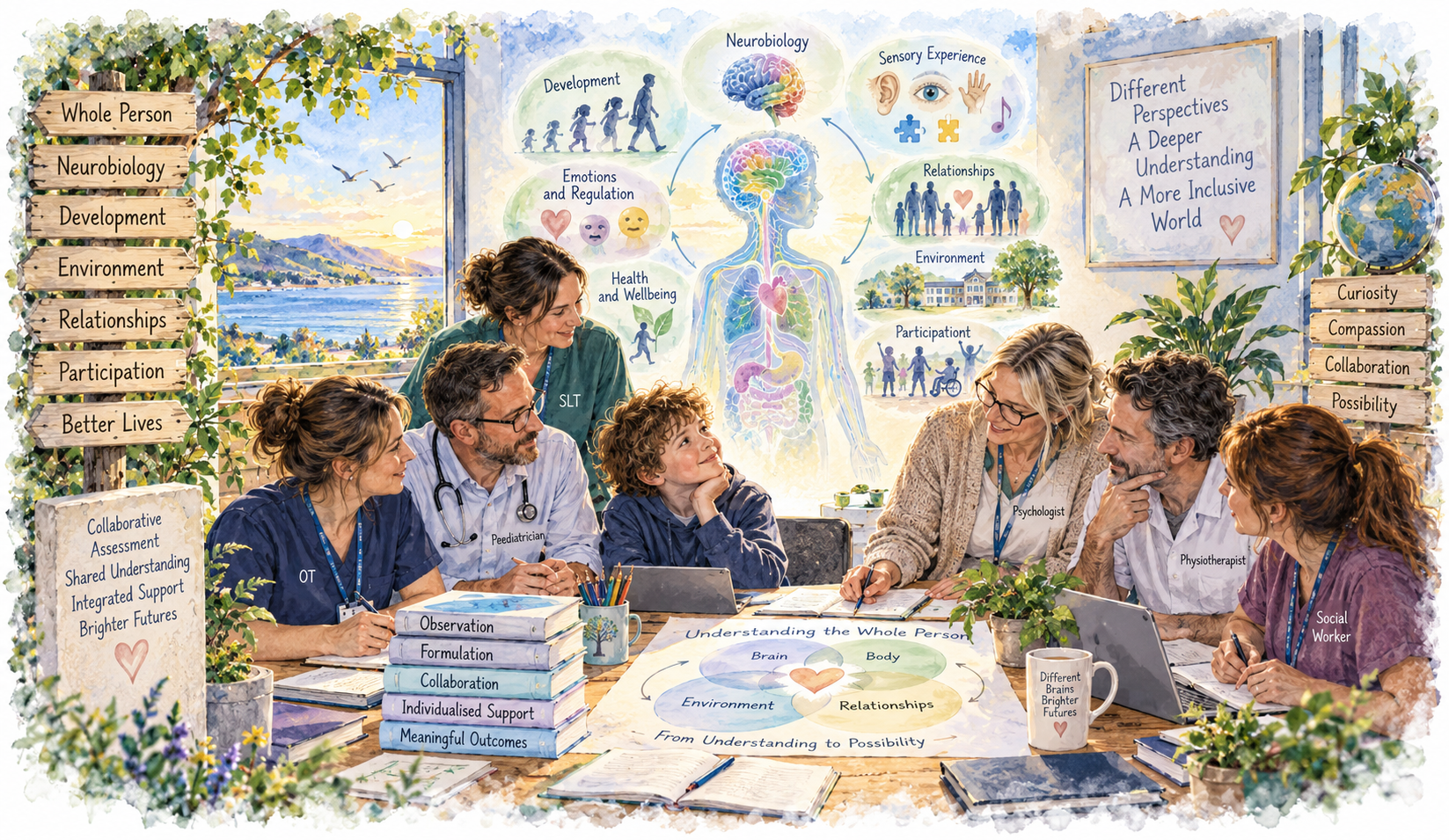
Start with what is happening
Use an integrated formulation frame to organise hypotheses without prematurely privileging one domain.
Examine state, environment, relationships, demands and predictive context.
Explore autonomic state, interoception, sensory processing and access to higher-order functions.
Revisit formulation, context and whether intervention assumptions match the person's current needs.
Use a shared whole-person model while retaining profession-specific expertise.
Move from accessible synthesis into advanced neurobiological and developmental resources.
A way through
Look beneath what you can see and begin with the whole person.
Consider the systems, experiences and conditions that may matter.
Bring the pieces together without assuming one explanation is the answer.
Use understanding to guide supportive next steps and useful resources.
Explore
Different domains can interact. These are places to explore, not conclusions about the person.
Explore nervous-system organisation and mechanisms relevant to behaviour.
Consider interoception, autonomic state, energy, sleep and other physiological contributors.
Integrate developmental trajectories with current presentation and context.
Examine access to inhibition, flexibility, planning and working memory.
Consider prior experience, expectation, uncertainty and learning.
Bring domains together as revisable hypotheses rather than diagnostic conclusions.
Consider
Understanding develops when we consider how different conditions may interact for this person, in this context, at this time.
Possible contributors are hypotheses to explore, not conclusions about the person.
Find a way forward
These resources can help deepen understanding of what may be worth considering. They do not determine why a particular person is behaving in a particular way and do not replace individual clinical assessment, diagnosis, medical advice, safeguarding or other appropriately qualified professional support.