L3 - Summary
The Living Brain - Summary
A concise resource presenting the essential concepts and structure.
Free Library Resource
Read summary
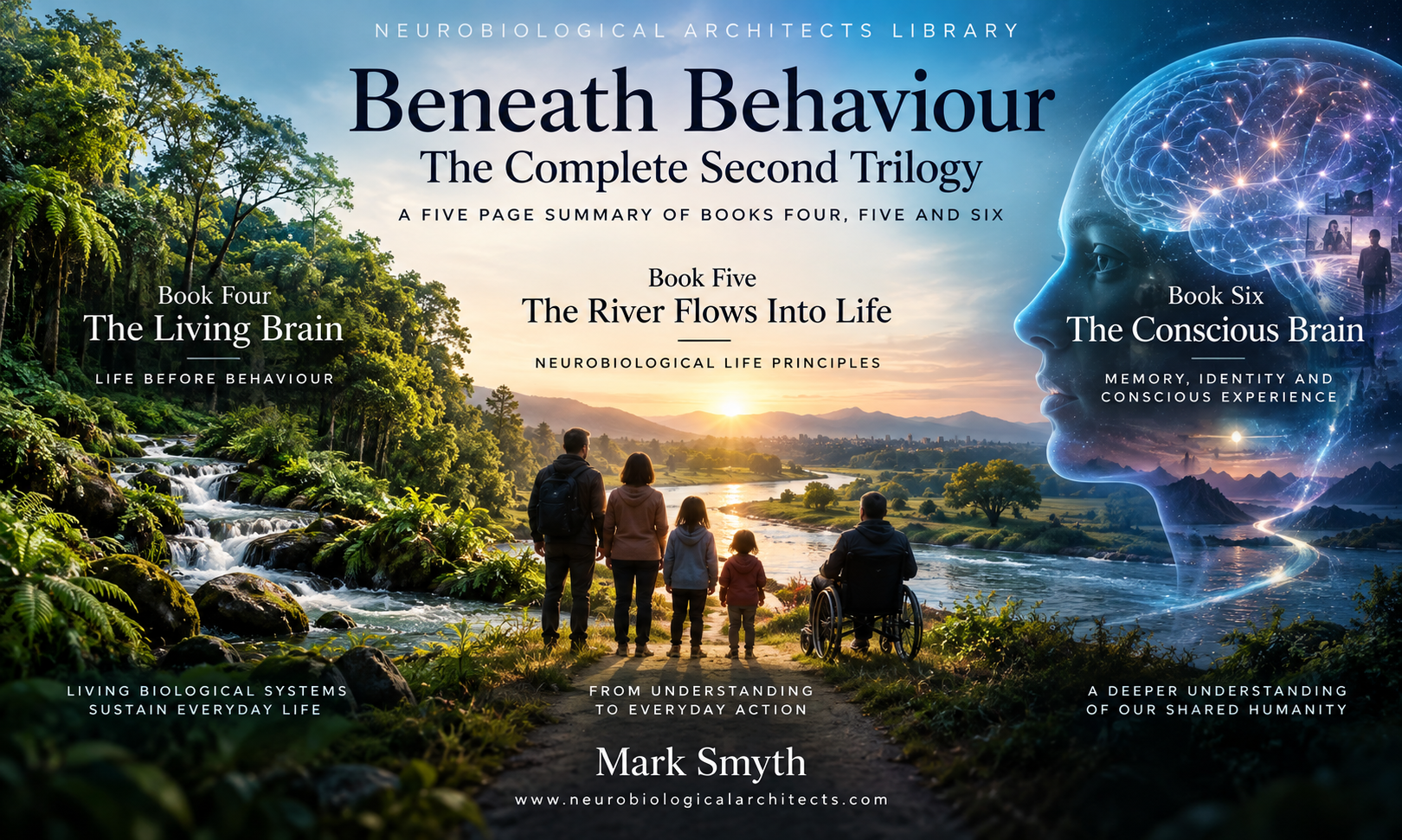
Beneath Behaviour brings together three perspectives on the person behind behaviour. Book Four explores the brain as a living organ. Book Five translates that understanding into everyday principles. Book Six investigates memory, identity and consciousness. Together, they encourage curiosity about what supports a person’s capacity to learn, connect and participate, while keeping scientific explanations open to revision.
Book Four · Life Before Behaviour
The Living Brain
A living community
The Living Brain begins with the needs of living cells. Before a brain can support thought or behaviour, it must obtain energy, maintain its internal environment, communicate and repair itself. The rainforest metaphor captures this interdependence: visible activity depends on a wider community that sustains it.
Neurons carry electrical and chemical signals, but they do not work alone. Astrocytes support metabolism and local regulation; microglia contribute immune surveillance and circuit remodelling; oligodendrocytes form myelin; and vascular cells help regulate exchange with the bloodstream. Behaviour emerges through interacting systems rather than a single control centre.
Energy prediction and adaptation
The brain’s activity requires a continuous supply of usable energy. Sleep, illness, stress and sustained demands can influence everyday capacity. The practical implication is to consider whether a task fits the person’s present resources, without assuming that outward behaviour reveals a specific biological deficit.
Previous experience also shapes expectations. The book uses predictive processing to explain how a brain anticipates events and revises its models when outcomes differ. Prediction is important across neuroscience, while the broader framework remains a family of theories rather than a complete explanation of every behaviour.
Plasticity allows nervous systems to change through activity and experience. Development, learning and repair therefore continue across time, although their possibilities and limits vary. Repeated support and manageable practice can help establish different patterns; change is neither immediate nor entirely under another person’s control.
From living processes to mental life
Attention selects information, memory carries experience forward and emotion contributes significance. Bodily signals, relationships and context influence these processes. Remembering is constructive, and reactivated memories can sometimes be updated; every act of recall does not inevitably rewrite a memory.
Consciousness introduces a further question: why does biological activity have a felt, subjective aspect? The book distinguishes processes associated with awareness from a complete explanation of experience itself.
Its closing message returns to the river metaphor. Visible behaviour has many contributing sources. Supporting someone means looking at the whole situation, including communication, bodily needs, learning history and environment. Biological understanding can deepen compassion and improve questions without supplying a diagnosis from observation alone.
Book Five · Neurobiological Life Principles
The River Flows Into Life
Book Five asks what we should do with an understanding of the living brain. Psychology describes experience, learning and relationships; neurobiology examines the living mechanisms involved. These perspectives complement one another. The author’s Living Mind Framework connects biology, psychological processes, behaviour, relationships and life outcomes through continuing feedback from experience.
Six principles for everyday judgement
Every interaction changes a brain. Repeated greetings, explanations and responses to difficulty contribute to what people expect from one another. The principle highlights the importance of experience; it does not guarantee lasting change from each encounter or a particular response from another person.
Nothing changes unless you do. Insight needs opportunities for action and practice. A manageable change, such as explaining a transition or asking before correcting, can be repeated and adjusted. Resources and environmental barriers also matter; people do not control every circumstance they face.
Accept where you are. Honest recognition of current strengths, needs and capacity provides a realistic starting point. Acceptance does not require approving of harm or giving up on change. It helps identify a next step that is possible now.
You cannot control other people. We can offer choices, set boundaries and change our contribution to an interaction. We cannot directly determine another person’s feelings, thoughts or willingness. Influence works through the conditions we help create, alongside respect for their autonomy.
Responsibility builds better brains. Responsibility means recognising one’s contribution, learning from consequences and taking part in repair. Humiliation can obstruct this process. Expectations should fit capacity, while adults and organisations also examine the demands and supports they provide.
Every small choice builds your future. Repeated actions can develop into familiar habits and relationship patterns. The stonemason building a cathedral represents how modest contributions accumulate. One lapse does not determine a future, and consistency remains useful only when the pattern is helping.
Applying the principles
At home, predictable routines and attentive interactions can support connection. Repair matters when adults misunderstand or respond sharply. In schools, belonging, accessible tasks, clear transitions and useful feedback support participation. Staff and caregivers need practical support themselves.
Adult relationships develop through recurring experiences of responsiveness and trust. Repair requires participation and does not imply tolerating harm. Leaders shape culture through their response to questions and mistakes, together with workload, resources and organisational decisions.
The book also highlights sleep, movement, nutrition, breathing, relationships, purpose and recovery. Sustainable living means workable care under real conditions rather than perfection. Becoming a Neurobiological Architect names intentional influence, not a professional qualification or control over another person’s development. Its starting point is one ordinary interaction approached with greater curiosity and care.
Book Six · Memory, Identity and Conscious Experience
The Conscious Brain
Book Six asks how life became capable of experience. It begins before nervous systems, separating the observable capacities to sense, process information and respond from the question of whether anything is felt. A sophisticated response alone does not establish consciousness.
From early life to social minds
Living cells regulated themselves and responded to their surroundings long before brains existed. Nervous systems expanded the possibilities for rapid communication and coordinated action. Nerve nets, ganglia and centralised brains illustrate different forms of organisation, rather than one universal ladder of progress.
Prediction and memory allowed previous experience to guide later action. Social life added the demands of recognising individuals, remembering interactions, anticipating intentions and cooperating. Language and culture extended what people could learn together beyond what one individual could discover alone.
These capacities help frame questions about consciousness without identifying a first conscious moment. Animal research examines behavioural and neural evidence, while recognising that subjective experience is inferred rather than directly observed. Different forms of consciousness may exist without resembling human self-reflection.
Memory and the continuing self
Memories depend on interacting networks. The hippocampus helps organise many new memories of events, while distributed systems contribute their features and later reconstruction. Consolidation, supported partly by sleep, changes representations over time.
Recall combines retained information with current knowledge, emotion and context. Vividness is not the same as accuracy. Under particular conditions, reactivation can also permit updating through reconsolidation. Memory is therefore useful for adaptation without functioning as a perfect historical recording.
Autobiographical memory connects personal events and facts into a developing life story. The book distinguishes this narrative self from the immediate sense of being a subject of experience. Memory loss can affect these aspects differently: some skills, emotional responses or familiar connections may remain despite difficulty recalling events. Dignity does not depend on being able to recount a life story.
Three approaches to consciousness
Global Workspace Theory proposes that information becomes consciously accessible when it is made widely available to other systems, such as those supporting memory, report and planning. Its theatre metaphor distinguishes the spotlight from extensive processing backstage.
Integrated Information Theory connects experience with a system’s integrated causal structure. Its proposal goes beyond counting connections or stored information, and its mathematical claims and testability remain debated.
Predictive processing describes perception as inference shaped by expectations and sensory evidence. It connects learning, action and perception, but explaining inference does not by itself explain why experience feels like anything.
The book compares these proposals without declaring a winner. Better measurements, competing predictions and interdisciplinary investigation can advance understanding while fundamental questions about conscious experience remain open.
The Shared Message of Books Four, Five and Six
Bringing the trilogy into everyday life
The trilogy links understanding with responsibility and humility. Book Four explains why bodily needs, cellular activity and experience matter. Book Five asks how this knowledge can guide daily action. Book Six reminds us that a person’s inner life cannot be fully inferred from outward behaviour or reduced to a single mechanism.
Look beyond the visible moment
Begin with what happened rather than a label. Describe the situation, the demands present and the person’s account where available. Consider communication, sensory conditions, recovery, previous experience and relationships. Separate observations from possible explanations so that new information can change your understanding.
An integrative account can hold boundaries and compassion together. Understanding the conditions behind an action does not erase its effects. It helps identify a response that supports safety, participation and learning while respecting the person involved.
Choose one manageable change
Select a recurring situation and one part you can influence. This might be a clearer instruction, a predictable transition, an accessible way to ask for help or a different response to a mistake. Small changes are easier to repeat and evaluate than broad promises to transform everything at once.
For example, a difficult arrival at school could prompt adults to examine noise, uncertainty, communication and the sequence of demands. A consistent greeting and clearer next step may help. Whether they help this pupil needs to be observed and discussed, rather than assumed from the principle alone.
Learn through feedback
Notice what changes over several occasions. Ask whether the person has more access, choice or opportunity to participate. If the adjustment is not helping, reconsider the explanation and the support. A useful framework remains open to revision rather than turning every outcome into confirmation of itself.
Make space for repair and recovery. Adults need conditions that allow them to respond thoughtfully, including realistic workloads and support. Repeated difficulty may indicate a need for shared or organisational change rather than greater individual effort.
Keep evidence and interpretation distinct
The rainforest, river, cathedral and theatre are teaching metaphors. The Living Mind Framework and life principles are the author’s synthesis. Theories of consciousness are proposals under investigation. These distinctions allow the ideas to remain accessible without treating every explanatory image as a proven mechanism.
The questions to carry forward are practical: What might this person be experiencing? What makes participation difficult? What support is missing? What can I influence? What would help me reconsider my explanation?